
By Leslie Price
There is a lot of advice out there for parents of babies or young children, but as your kids get older, it all gets more complicated. Puberty has stretched out, meaning big emotions at earlier ages. The ubiquity of screens can bring new challenges, from tricky social dynamics to concerns about unsafe content. We all know we need to be having multiple conversations over the years to help our kids navigate this world, but sometimes it’s hard to find the right way to get started — or to know what to prioritize.
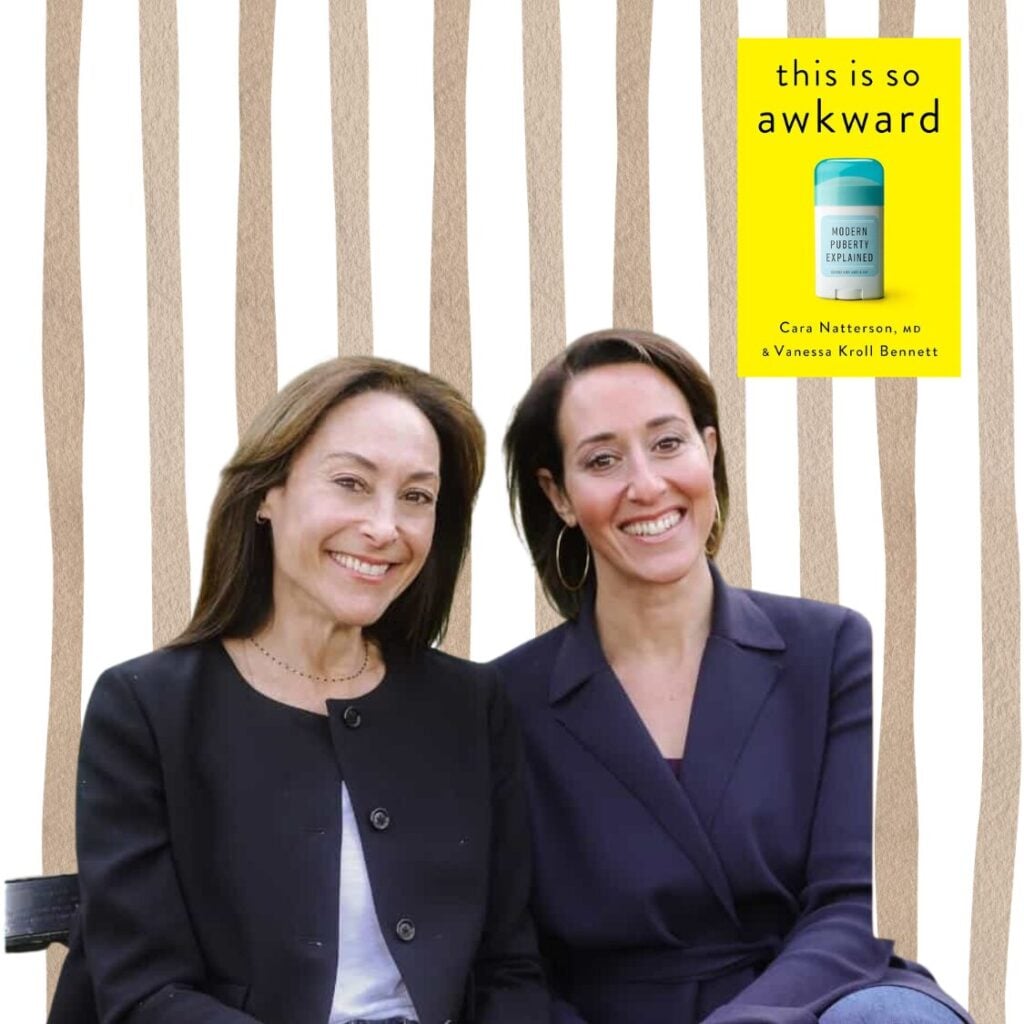
Last week, I had the opportunity to talk with Dr. Cara Natterson and Vanessa Kroll Bennett. They’re an incredible resource for parents of teens and tweens, whether you listen to their podcast, This Is So Awkward, watch their short-form videos on social media, or read their books, including This Is So Awkward: Modern Puberty Explained, Decoding Boys: New Science Behind the Subtle Art of Raising Sons, and the updated cult classic The Care & Keeping of You.
They’ve seen it all, heard it all, and are raising their own kids. They’re also so reassuring! Below, they share their wisdom on broaching tough topics and what parents should be aware of now.
I want to start off by talking about puberty now, versus puberty when we were growing up in the ’80s and the ’90s. What has changed?
Dr. Cara Natterson: [Anecdotally], people saw increasingly young girls get breast buds. The biggest study to upend the definition of when puberty started came out in 1997, and it collected data through the early and mid ’90s. It found that puberty was beginning earlier.
In girls, the first physical sign is breast budding. The first physical sign in boys, for the most part, is penile and testicular growth. In the ’90s, it was like, what is happening to our girls? They’re going into puberty at an average age between eight and nine. But the same forces that were impacting physical changes in girls were impacting physical changes in boys. They just weren’t being noticed. The emotional changes, those mood swings, those were happening earlier, too.
Vanessa Kroll Bennett: One of the most common refrains we get is, “Why is my 10 year old acting like a 15 year old?” Behaviors we normally attribute to a teenager are also happening earlier. Parents need the tools to support kids who are riding this rollercoaster.
How can we be sure that the emotional shifts are happening earlier?
Dr. Natterson: I always touch on the mood swings because they are a result of the same sex hormone [that drives] the physical changes. We used to separate them into two buckets; we called it puberty and adolescence. Now everyone recognizes the Venn diagram overlap. Puberty is the sexual maturation of the body, but the forces that control that maturation also impact the way your brain feels.
It would be one thing if the hormones steadily rose nice and slowly, but they don’t. They rise and they fall and they rise and they fall every eight or 10 hours. When you start looking at the graphs of people whose hormone levels are being monitored 24 hours a day…you literally see what is happening in your house on those graphs. It’s the delta between the high highs and the low lows that feel so bad in your brain. [When it comes to] brain development, the emotional center of the brain is dominating at this age, and it’s impacted by these hormonal shifts.
One of the first interviews Vanessa and I did on our podcast was with Dr. Louise Greenspan, an endocrinologist based in San Francisco and one of the most important researchers in this arena. She said that the first sign of puberty is a slamming door.
At least for me, knowing about how the brain develops is helpful. Is it also helpful for kids to understand?
Dr. Natterson: When we wrote our health curriculum for schools, having spent time with thousands of kids across the country and thousands of parents, we knew what got kids engaged and interested. Parents assume, “Oh, my kid’s not interested in the science.” Yes, they are. We’ve talked to all of them about the science and they’re on the edge of their seats because it explains them to themselves.
All of a sudden, the stuff that feels mysterious, shameful, confusing, or out of control has an explanation. You’re not a bad kid, you’re not a bad person, you’re not a bad human being – you’re a work in progress. It’s okay. Because what makes the mood swings harder, what makes the crappy decision making harder, what makes the reactivity harder is that the shame layered on top.
It’s important for kids to [know that] this is not forever, it is a stage of development.
How do parents start these conversations?
Vanessa Kroll Bennett: Validate what’s going on. The goal is to get them talking, to get them engaged. It can help to ask [questions like], What are you seeing with your friends? Are people arguing more? Are people getting upset in class in a way they didn’t used to? There’s no one-size-fits-all. Some kids love the science. Some kids just want a hug and reassurance that you love them no matter what, even if you literally cannot stand them in that moment, just because they feel so crummy about themselves.
The whole point is for kids not to feel like they’re under the microscope.
Is it helpful to talk about the mistakes we made when we were in this phase of life?
Dr. Natterson: Every kid is different. My kids came from two completely risk-averse parents. Their challenges are going to look different than a kid who’s scaling the bookshelf at 14 months old. You have to meet the kid you have where they are.
When you lean into your own storytelling repeatedly, that’s a sign you haven’t really left your baggage at the door. There are moments where bringing your own stories is impactful – if it’s hilariously funny, if you are the butt of the joke. That is extraordinarily effective.
Vanessa Kroll Bennett: Cara basically was the best behaved teenager in the entire world. So she feels comfortable sharing her one screw up. For those of us who made more mistakes or went further afield, you want to be really careful about sharing. Once you tell your kid something, they will never unsee it or unhear it.
Take your own experiences, process them with friends, your partner, or a therapist, and then think about what you want for your kid and how to communicate it to them. I know people who experimented a lot sexually when they were younger, and now recognize they were [seeking] love or connection. If I know that, and I know what I ultimately want for my kid is for them to find meaningful, loving, respectful relationships, let me lean into talking about that, exploring that. Start with their friendships. How do their friends treat them? Do they feel loved? Do they feel respected? Do they feel heard? As they get older and into romantic relationships, how are you feeling about the way your girlfriend or boyfriend is treating you?
There will be people in your life who you’ll move from shielding your kids from to using as a teachable moment. It’s going to be different in every family. Addiction or gambling are good examples where there are very real consequences to these choices. Your job as the parent is to find a way to communicate that without being judgemental.
We’ve talked about the physical changes of puberty, but how has the conversation around sex changed? There’s obviously an enormous bogeyman in the room, which is technology. What should parents be aware of?
Vanessa Kroll Bennett: Porn. Parents should be aware of porn. Technology allows kids to see free porn on any platform, including Google Maps and Pinterest. Kids are just Googling boobs, and all of a sudden they get sent down a rabbit hole of violent, aggressive, non-consensual, misogynistic porn. They were just being curious, as kids are.
Talk about sex and porn before they are shown it or stumble upon it. The average age in this country is 12 for porn exposure. That’s based on data from a report in 2023, and the data was collected even earlier than that, which means it’s probably earlier now. 15% of 10 year olds have seen porn. Parents are like, I’ll wait ‘til they’re 15 or 16. No, no, no, no, no. You have to have the conversation. And any term you use, you have to define. The first porn talk is just, “Hey, have you ever heard this word before?” And they’ll be like, “Yeah, it’s bad and sex.” And then you just say, “Well, I just want you to know it’s not for kids, it’s for adults if they choose, and it might be confusing. And if you’re ever shown it, you come tell me. I’m not going to freak out.”
When we talk to parents about this, they look at us like deer in headlights. They can’t believe they have to talk to their kid about it. But the truth is, it’s us or it’s the pornographers that are writing our kids’ understanding of sexual relationships.
Dr. Natterson: When we teach parents how to have conversations about porn, we start with teaching them about how to have conversations about sex, because the way we were sex educated was extraordinarily limited. In our curriculum, we teach there are four kinds of sex. There’s penis and vagina sex, there’s oral sex, there’s anal sex, and there’s sex with yourself (masturbation). We walk through sort of the logistics of each, and the risks and benefits, and then we’re like, “Ask us anything.”
If you limit your conversation to penile and vaginal sex, for instance, you may have a kid who’s engaging in oral and anal sex who doesn’t think they’re having sex and doesn’t feel like they can engage in the conversation with someone.
It’s a long, winding road to get to [the convo about] porn. These two conversations can happen a bit in parallel, and can [go] into increasingly sophisticated levels. It’s not one talk.
What are other areas where there’s a gulf between what parents are thinking about and what you’re seeing?
Dr. Natterson: It’s not [just] phones in schools, it’s devices in schools. The things that are happening at the back of the classroom are problematic for socialization and learning. It’s gambling during class, watching movies, shopping, porn. 40% of porn viewing is reported to have happened at school. Just stop and think about that one for a second. Phones out of schools is the first step in terms of helping kids engage, but it’s so much bigger than the phone. Vanessa, what’s yours?
Vanessa Kroll Bennett: It’s that adults think that kids aren’t seeking connected, loving, meaningful relationships. Adults [can] dismiss young people as vapid, superficial, and not deeply feeling or deeply thinking. Particularly with boys. When I think about the conversations we’re having (or not having) with them…the misalignment of parents assuming boys don’t want to talk about feelings, that boys don’t feel deeply, care deeply, want loving, meaningful relationships. That’s a place where we could do a lot of work, particularly [now]. It’s really a priority, from my perspective, that people talk to and treat teenage boys as people who feel things and think about things in deep and really caring ways.
The book Decoding Boys is so helpful. Culturally, it seems like we have really focused on girls in terms of messaging around danger – for good reason! – but perhaps we have under-focused on the dangers for boys.
Vanessa Kroll Bennett: She was ahead of her time, right? I completely agree with you. It’s not a zero-sum game. I started my career working with girls in sports. You can’t have healthy, safe, happy girls if you don’t also have healthy, safe, happy boys. We’re all in society together.
The tone of Care And Keeping of You is incredibly positive, which feels retro to me. It’s a good gut check, because with everything going on in the news and all of the messaging we’re getting as parents, there’s just so much concern, so much fear, so much to worry about.
It is good to not approach everything with negativity. How do we make kids excited to go through this part of their lives?
Dr. Natterson: Valerie Shaffer wrote the original book. [She decided] to come at it from the perspective of the cool aunt. That set up a framework that was magical. That’s the baton we took and ran with. When possible, everything we do is joyful, non-alarmist, and non-fear-based.
Vanessa Kroll Bennett: Everyone has scared the fuck out of us, but we can do this with joy and laughter and optimism. There’s research that, when we internalize the negative messaging and pass that on to our kids, it becomes a self-fulfilling prophecy. Kids respond to the positivity in kind and the negativity in kind. If we assume that middle schoolers are going to be shit heads, then middle schoolers are going to act like shit heads.
Positivity is not sexy. The message that you should be afraid, that your children are at risk – that’s what sells. But we will continue to beat the drum that this is a stage that can be joyful, funny, connected, loving, and beautiful. Parents don’t need to be terrified, because when you’re scared you make shitty decisions. When you feel good, empowered, and calm, that’s when you make the best decisions as parents.