
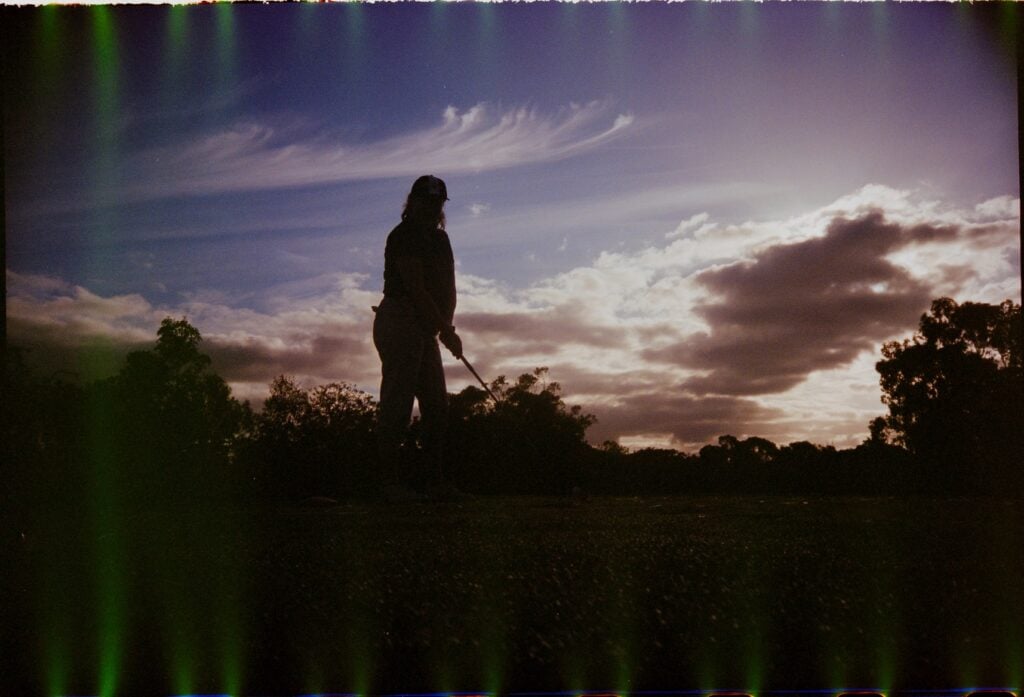
By Holland Sweet
I have done some stupid things in my life. But recently I’ve begun to wonder if taking up golf at sixty might be the stupidest of all.
How it All Started (Blame My Friend Nancy)
My father tried to introduce me to golf when I was a teenager. This is the same man who taught me tennis, got me up on ice skates, and cheered me on from the sidelines of high school soccer matches in the ‘70s, when girls playing soccer was considered mildly pioneering. But golf? I recoiled. With its clashing polyester and tempo of a tranquilized tortoise, golf seemed designed for a different kind of person. The kind who drove a Cadillac Coupe DeVille voluntarily. Watching golf on television? I’d have rather watched paint dry.
Then came my late fifties, my divorce, and a former golf marketing exec friend named Nancy, who looked at me over a glass of wine with the calm certainty of someone delivering a business pitch and said: “If you want to meet men, you need to get on a golf course.”
I laughed. Then I booked a lesson.
Nobody Warned Me About the Physics
What they don’t tell you when you sign up for golf lessons is that being a lifelong athlete is not only unhelpful, but also a functional liability. I had played tennis for decades. I had keen hand-eye coordination. I had confidence — the smug, preemptive confidence of someone certain they’d do fine at something never before ventured.
I didn’t do fine.
Initially, my golf pro, Sue, tried to keep it simple. Always have a target and take dead aim. Makes sense until you get to the execution. Stand sideways to your target, rotate your torso, shift your weight while holding your head perfectly still, then initiate the downswing with your legs before your hands reach the top, and swing the club from the inside along a precise arc.
Executing a golf swing from a dead stop was more than my 60-year-old brain and body could process. Unlike tennis, I had no muscle memory to count on. I attempted to perform this sequence repeatedly: on grass, on sand, in wind, and often in front of judgemental strangers. The late Robin Williams described it as taking a broken staff and hitting a ball into a gopher hole while avoiding trees, bunkers, and water intentionally placed in the way — and then calling the resulting despair “a stroke,” because you feel like you might be having one. Then you do it for seventeen more sadistically conceived holes. Willingly.
The learning curve is not steep so much as a sheer cliff face with no handholds. And everyone had advice. If one more person told me to keep my head down, my inner angsty teenager was going to make a very poor decision while holding a nine iron.
The Solitary Sting of a Shank
Golf can be uniquely humiliating. In team sports, a bad outcome rests on many shoulders. In golf, there is no such comfort. Every shank belongs to you. Every ball nestled in a sand trap is your fault. Every three putt is a character flaw.
As a lifelong athlete who had captained tennis teams in high school and in my thirties and forties, I thought I understood how to manage frustration with my own performance. I did not.
Golf introduced me to an entirely different level of failure as well as a Zen-like acceptance. You will frequently be awful, this is normal, and the only appropriate response is to take a breath, shake it off, address the ball, and be terrible again.
But then — oh, but then — comes the shot. Something clicks. The contact is clean. The ball rises in a magnificent arc over the fairway and lands, amazingly, where intended. You will spend a significant amount of money and time chasing that feeling, like a labrador retriever who has spotted a tennis ball and will not rest until she has it in her mouth.
The Unexpected Benefits (There Are Many)
Golf has delivered unanticipated rewards. My brain is an overachieving multi-tasker, prioritizing to-do lists, planning a daughter’s wedding with five months’ notice, worrying about my ninety-year-old parents’ health. On the golf course, all that goes away.
There is simply too much to think about: the wind direction, the lie of the ball, the distance to the pin, the pace of play, the water hazard on the right.
My phone stays in the car. For those two to four hours, I am unreachable, unbothered, and — this is the miracle — present. Friends who have played for years describe the meditative quality of the game. I used to find this notion deeply questionable. I am beginning to understand it.
Then there is the walking. Eighteen holes covers roughly four to six miles, which you’ll clock without noticing because you’re too busy thinking about your next shot.
The Women’s League: Finding Community
Last year, I joined the women’s nine-hole league at my golf club. I was terrified. I was certain I wasn’t good enough, that I would embarrass myself. I feared that these women would see me as incompetent.
What I found was a group of women who cheer for a well-struck ball with genuine enthusiasm, who console you after a bad shot with the empathy of people who have been there themselves, because many of them have. Just last Wednesday, for instance. We walk, we talk, we laugh, we malign sand traps together.
Golf, it turns out (and as Nancy neglected to mention), is almost entirely segregated into women’s and men’s leagues. The very sport she prescribed to meet men deposited me squarely among supportive women.
About the Men
I did, eventually, meet one. A golfer, as fate (or Nancy) would have it. A genuinely talented one who has played his entire life. John is a natural athlete who makes it look effortless in that quietly infuriating way. He’s generous on the course, tries not to over-coach (most of the time), and has been patient with me in the manner of someone who understands that golf can’t be rushed. And he’s older than me, which gives me hope.
John, it turns out, would rather play pickleball.
I learned to play golf to meet a man. Frivolous, perhaps; but it took me on a path I had not anticipated. There is a lesson in the gap between what we seek and what we find. Now, I am a woman who plays golf, fully open to whatever challenges the game throws me on life’s back nine.
The Bottom Line
The learning curve is a bitch. The sport will humble you in ways that will feel personal because they are. You will lose balls you cannot explain. You will stand on a driving range one day and do something so unfathomable that your partner will advise you to forget all about it.
But you will find quiet. You will find community. You will find a walk among a line of trees and open sky where the noise of the world cannot follow. And on one glorious afternoon — when everything comes together and the ball soars as intended and your significant other cheers you on — you will understand why people, even those over sixty, have been chasing this feeling for a very long time.