
BY Julia Craven
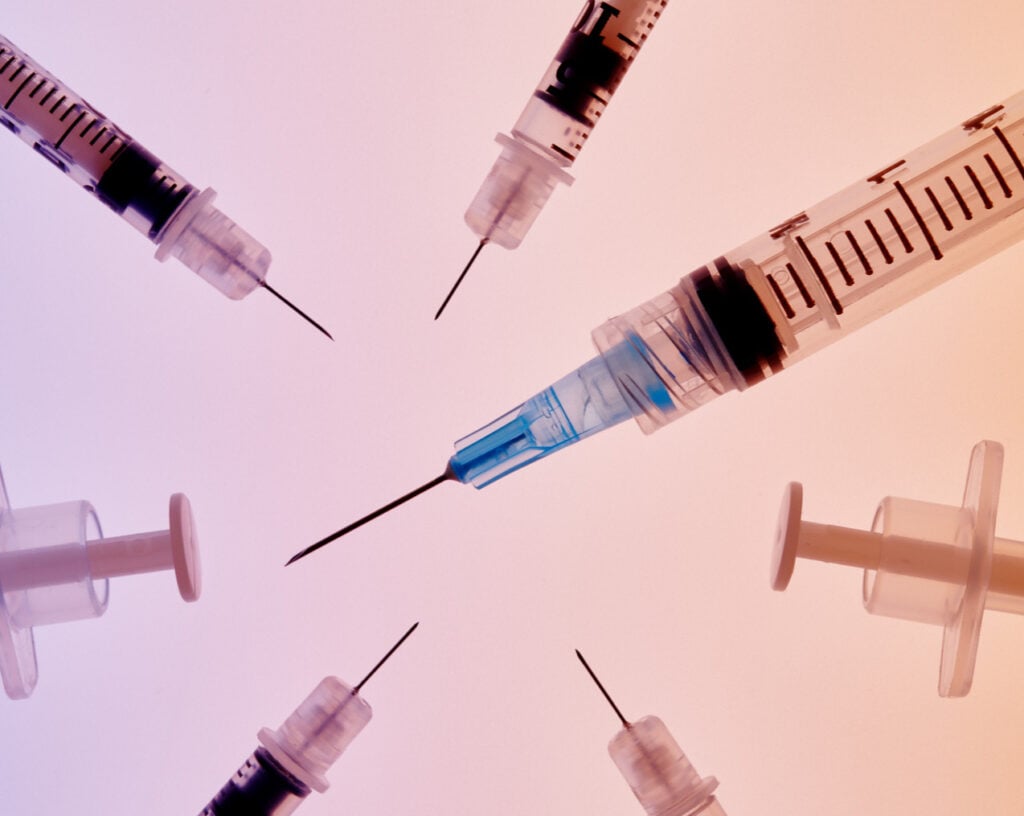
Peptides are having a moment. They’re on your feed, in your group chats, and, increasingly, in unlabeled vials people buy from an obscure WhatsApp number and inject at home. The pitch is intoxicating: cutting-edge science is being shot straight into your body, helping you sleep better, build more muscle, lose weight, and slow the aging process.
Reality can be grimmer. In July, one physician told a local NBC station that he’d recently hospitalized a patient who suffered severe psychiatric symptoms after mixing a pile of vitamins and peptides. Which product caused it? He had no way of knowing. This is part of what makes the peptide landscape confusing. Celebrity, wellness influencer, and Silicon Valley biohacker testimonials can drown out the stories of people who’ve had negative health consequences.
I spoke with two experts to help sort out what peptides are, why they’ve exploded, and what consumers should know.
So, what actually is a peptide?
“Peptides are small chains of amino acids that are put together to form an active component,” says Dr. Katrin Svensson, an associate professor of pathology at Stanford who directs the university’s Metabolic Core Facility. “These are made naturally by the body, and they act on a cell to induce some sort of physiological response.”
Your body makes thousands of them, like insulin and endorphins. The most well-known synthetic peptides are semaglutide and tirzepatide, the active ingredient in GLP-1 medications Ozempic, Wegovy, Zepbound, and Mounjaro. Biohackers are using a different set of injectables that are also synthetic. Some of the most talked about options are CJC-1295 (boosting metabolism), Melanotan II (melanin production), BPC-157 (wound healing), and TB-500 (muscle repair).
If they’re “natural,” why all the fuss?
“One of the biggest misconceptions is that because some peptides are already made naturally in the body, they must be safe to take. But that is simply not true,” says Dr. Jessica Alvarez, an associate professor of medicine at Emory University School of Medicine. “How they’re taken, how much is taken, and for how long are all important considerations, even for ‘natural’ products.”
Injectables enter the bloodstream faster and more intact than pills, which get partly broken down in the stomach.
“Say that there’s lead or some other type of contaminant, you will get this directly into your bloodstream,” Svensson says. “You may get sepsis and die. Injectables have much greater risks.”
It doesn’t help that most of the unregulated biohacking peptides have never been rigorously tested in humans. Animal studies have shown that growth hormone related peptides — like CJC-1295, TB-500, and others — can cause cancer. There’s so much we don’t know about the long-term safety or biological effects. It’s unclear how or if the options coveted by biohackers will interact with medications, supplements, or even other peptides.
Yikes. So why are people injecting them all of a sudden?
“A lot of the peptides that are used in the biohacking community are sort of inspired by the GLP-1 drugs,” Svensson says. “That was really the first time it was shown in humans that these peptides can be very potent.”
Semaglutide was approved for the treatment of Type 2 diabetes in 2017 and, at a higher dose, as Wegovy, for weight management in 2021. The results of those drugs reset the category. If one injectable peptide could do that, the logic goes, why not try peptides for everything else?
Alvarez also attributes the rise in peptide usage to old promises of miracle drugs for anti-aging, weight loss, and a “better” body being delivered through a new system.
“What’s different now is the reach of social media, the rise of influencers, and the rate that people are being fed these promises. Peptides are often marketed as cutting-edge science and a way to control biology to get quick results,” she says. “Combine that with anecdotal success stories shared online or by friends, and safety concerns can be outweighed by perceived benefits.”
Why is it so easy to access them?
Because almost nothing stands between you and a vial. The peptides driving this trend are sold openly online under labels reading “research use only” or “not for human consumption.” That disclaimer allows vendors to ship unregulated compounds without a prescription and without oversight.
The supply chain is short, cheap, and active. These injectables, which are initially sold as powders, are manufactured overseas, largely in China, then sold on research chemical sites, through resellers, and promoted on TikTok, Telegram, and Discord. Buyers reconstitute the powder with bacteriostatic water, draw it into a syringe, and inject at home, following a tutorial from an influencer or, lately, via Custom GPTs.
Is the FDA doing anything about this?
Sort of. Peptide regulation is currently split into two camps: GLP-1s, which are approved drugs, and everything else. To understand what’s being done about the gray market, we have to start with the Ozempic shortage, which lasted from 2022 to 2025. During that time frame, compounding pharmacies could make their own versions of GLP-1s to meet the increased demand. Once the FDA declared the shortages resolved, pharmacies had until spring 2025 to stop since copies of approved drugs back in stock can’t be compounded.
Then there’s everything else, like the BPC-157s and TB-500s. These haven’t been through FDA approval, but the agency hasn’t ignored their existence. For instance, in 2023, it flagged BPC-157 as a potential safety risk, citing limited human data, and kept these peptides off the list of those pharmacies are allowed to compound.
But the ground is shifting. On July 23 and 24, an FDA advisory panel voted that pharmacies should be allowed to compound BPC-157, TB-500, MOTs-C (metabolic health), KPV (reduce inflammation), Semax (brain health), and Epitalon (anti-aging and sleep health). The panel did not approve a seventh peptide, Emideltide (sleep-inducing), since it acts on opioid pathways in the brain and could be addictive. Even though this vote recommends that pharmacies be allowed to compound these peptides, it doesn’t provide the FDA’s approval, meaning it isn’t an agency sign-off that the peptide is safe or effective.
Wait, what?
Yeah, it’s wild. Compounding lets a pharmacist mix a drug to order from a list of permitted ingredients. This was meant to handle edge cases — like whipping up something for a patient who is allergic to the dye in the pill they’re prescribed, kids who need a liquid version of an adult medication, or drugs in short supply.
Approval requires more evidence from clinical trials to give a verdict on the actual product. So the FDA just greenlit six peptides for compounding while still having no long-term safety or efficacy data, essentially creating a workaround to the approval process.
You should know that almost everyone advising the FDA on peptides has a stake in peptides. They either prescribe them, make them, or sell them. On previous panels, the seats were filled by academics and researchers. RFK Jr., who oversees the agency as Health and Human Services Secretary, has said he’s “a big fan of peptides” and has used them. He has the final say on whether the panel’s recommendations are adopted.
Wow. What do the experts have to say to people who want to try them anyway?
A resounding don’t even think about it.
“I always try to emphasize that it’s really not safe, and the risks are much greater than any sort of benefit that you may think that you need,” Svensson says.
Alvarez offers a good rule of thumb that can be applied to any trend: “As with most wellness products that are marketed today,” she says, “if something sounds too good to be true, it usually is.”