
By Camila Ball
I’m a business owner, a writer, a mother, and a citizen — a doomscroller pained by politics who, until that morning, had failed to show up beyond likes, shares, and elections.
When I learned of a Miami-Dade County commission meeting taking place on June 26, 2025, where an item regarding our county’s fiscal relationship with U.S. Immigration and Customs Enforcement was being discussed, I made a commitment to go and speak — even though I had never attended a commission meeting before. Not speaking out about the damage this agency is having on our communities means enabling it.
The contained environment of a commission meeting seemed safer than all the protests I intended to be a part of and skipped after overthinking about worst case scenarios. I’d seen those viral videos of people getting forcibly removed after going over their allotted time, but I wouldn’t go past mine.
At 9am Thursday morning, we arrive at the Stephen P. Clark Government Center, named after a county mayor known for his fairness to all communities across twenty-six years of service.
At the registration desk, I reach the part where the form asks me if I am for or against the item I am there to speak on. I stare blankly at the question.
Going on the record for being against an item about an already lawless agency with an increasingly authoritarian backdrop brings images of masked agents banging at my door, even though I’ve been a citizen for over 33 years.
I place the yellow sticker on my hip and meet my husband. We take a selfie with cheesy smiles, sending it to our family to commemorate our participation in the democratic process.
We reach the chamber and find seats in the center section, a few rows from the back.
I note a peculiar man in a suit, some kind of clerk, standing at the front to the left of the podiums. At one point, after an item is approved, he tells the crowd not to applaud.
As the commissioners go through the agenda, I polish my speech. I search for something true, potent, and uniting; wanting to trust law enforcement and preserve our community’s safety.
As a white woman who owned a business on a chaotic block of town, I’ve had largely helpful and positive interactions with police. That’s a lot of privilege in very few words. While I’m aware of the violent injustice that black and brown people face at the hands of police on a daily basis, my lived experiences kept me naïve.
We are over an hour into the meeting when The Chair says he’s going to call up those who want to speak on the item I am there for.
“They’re calling up the speakers for our item now,” I say to my husband, as I place my purse in my seat so I can make my way down.
It takes me a few seconds to realize something unusual is happening. The item has been deferred. I know what “deferred” means, but here it seems to carry a special legal meaning I’m not privy to.
The Chair is explaining that we still have an opportunity to speak and that he is going to call the speakers. Looking at me and gesturing with his hand, he continues, “I think there’s one there.” He clarifies that if anyone is to speak today, no one can ever speak on the item again, adding that it has been “indefinitely deferred,” which means it is not being discussed nor voted on today. He says it may not get brought up again, but if it does, and if anyone speaks today, then a public hearing would have already been had.
The crowd is just as confused as I am. Disgruntled murmurs fill the chamber, and a few individuals ask questions directly to the dais, and are being answered.
Embarrassed to take up space in a room with formalities that feel foreign, I ask, “why was it deferred?” to the dais. I ask in such a low voice that The Chair doesn’t look my way or answer.
The suit-clerk man by the podium, just a few feet ahead of me, does hear. He looks at me with a hard face, points his entire left arm towards the door, and says, “you need to leave.”
“For what reason?” I ask.
“You need to leave,” the suit-clerk-man repeats, now pulling on my right elbow. I bring my elbow back to myself.
“I’m trying to understand the process,” I say, about everything: this entire chamber process, the item, the deferral, him trying to kick me out. “You’re ejecting me?” I ask.
Seconds pass and two more people in suits, a man and a woman, come up from behind me. I plead, “I’m not trying to make a show, I can comply with the chamber rules. I am happy to sit.” I back towards the first row of chairs, stepping to the left, beginning to lower into the seat.
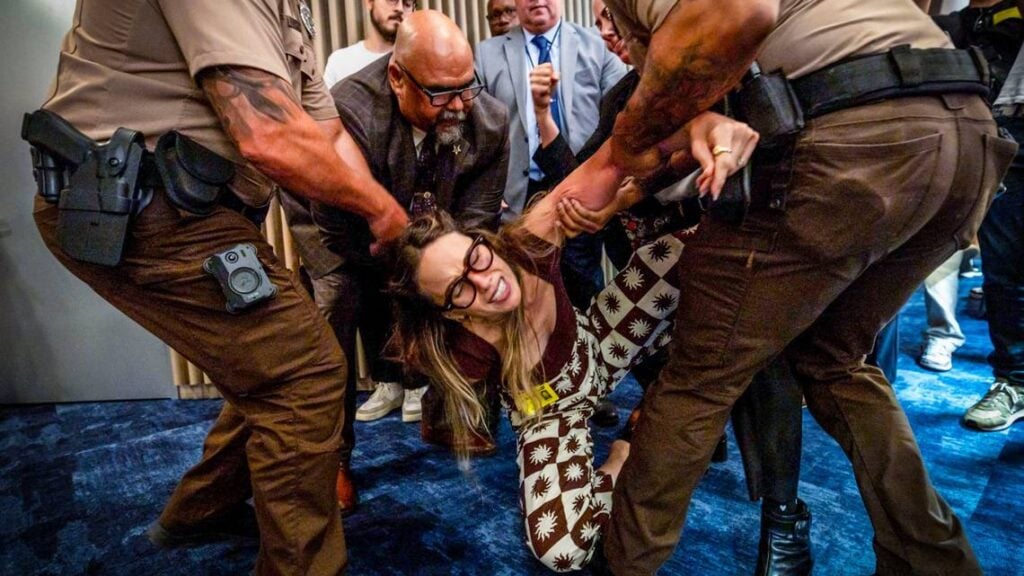
Neither the two men nor the woman care for what I am saying. They grab my arms and begin to force my body up the aisle.
I collapse. They pull my body and turn it around. Now everything is happening behind me. My gut turns. I do not consent to this.
Their fingers dig deeper into my soft arms, keeping my upper body pinned. I have my phone in my left hand and try to bend my forearm to pass my phone to my right. I’m fumbling to reach the camera with my thumb when a hand comes from behind me and snatches it.
I hear the crowd beginning to yell things. I can’t tell what.
I desperately wish someone would help me. I try to reach for the arm of a man standing on the aisle.
We arrive at the back of the chamber and I come back to my deflated body. Moments ago I had disconnected from it to avoid feeling the involuntary pulling of my entire being. Now I am on the floor.
“Let me go. I can stand and I can be quiet,” I say.
Surrounded by blurry figures, including the suit-clerk people, I hear voices from the crowd and a man holding a camera repeatedly asking what my name is.
Another man asks, “Can you walk?”
“Can I have a breath?” I respond, now unsure if I will even be allowed this.
I ask again. The gripping hands around my arms soften their pressure. I exhale, relieved to see the situation begin to defuse, and say, “I’m going to take a moment to center myself, and then get up and walk.”
A second later, a woman I haven’t seen before, dressed in a white satin halter and a black blazer, says, “No!” as she reaches in to grab me.
“What are you doing?! Let me go!”
The men lift me off the ground, and pull me away from this woman and towards the exit. The woman grips my leg and I resist the primal urge to kick it loose. No one is stopping her.
“You don’t need to do this, I just needed a moment.” As I try to get up, her arm hooks below mine, and my arm flails forward past her shoulder. The people controlling me are now officers in uniform. They clench my arms tighter, turn my body around, and suspend me in the air.
I now face the exit. Before I can put together what is happening, someone yanks my hair and my neck snaps back beyond what it can hold.
I lose my right heel. Instead of moving to the right towards the exit, my body is thrust to the left, and I’m thrown straight into a pedestal sign.
“Stop it!” I tell everyone and no one.
I am now being lifted by my hair. Safety escapes me. The world moves, and it moves me, but I am no longer there. I leave my body and numb myself.
For a split second, I see my husband. “My love!” I yell. We reach for each other’s arms and hold tight.
My body braces for impact as we approach the metal-framed doors, fully expecting to be slammed into them, too.
They miss the frame. My relief lasts only half a second before my husband’s arm disappears and they throw my body to the floor, a blue tightly-woven carpet, compressed by thousands of steps that came before my left cheek.
My arms are being pulled with more force than I knew possible behind my body, my right shoulder wrenched back beyond its natural limit. There is the weight of an adult actively pressing down on my upper back, and my hair is still being pulled behind me, restricting my neck and pinching my throat and airway. I can feel the pressure on my sternum further compressing my lungs and breath.
“I can’t breathe,” I try to explain in as few words as possible.
“If you can talk, you can breathe,” a woman says.
My wrists are being handcuffed for what feels like a lifetime. The rug is so dirty, I can smell it even through my constricted inhale.
They pull my arms, head, and body up until I am standing. A semi-circle of people stand around us, keeping their distance. I look down at the spot where my cheek had just been. A wad of hair, more than an inch thick, is left.
Someone gives me my right heel. I don’t know who.
I now face the white satin-halter woman directly.
“You’re under arrest,” she says.
Of course those words — which I had never heard directed at me — are shocking, but the handcuffs were kind of a giveaway.
“For what?”
“Assaulting a police officer.”
“What?! Who?!” I ask, now in complete shock.
“Me,” she says.
Considering whether I had lost consciousness at any moment, I follow her sleek back bun down to her sharp chin and the familiar white satin halter under a black blazer. I look her in the eyes. “If I did, I didn’t mean to.”
I notice a cute little star on her blazer, like the ones kindergarteners get in school, right before she says, “Tell it to the judge.”
∞
I was charged with battery on a law enforcement officer and resisting arrest with violence, two felonies. Both charges were dropped on March 11, 2026.