
By Jill E. Duffy
My friend DB bounded down the stairs carrying a huge bag of prunes. She was visiting for a few weeks and brought her own supply. “I eat five every day,” she said, chewing. “For osteoporosis.”
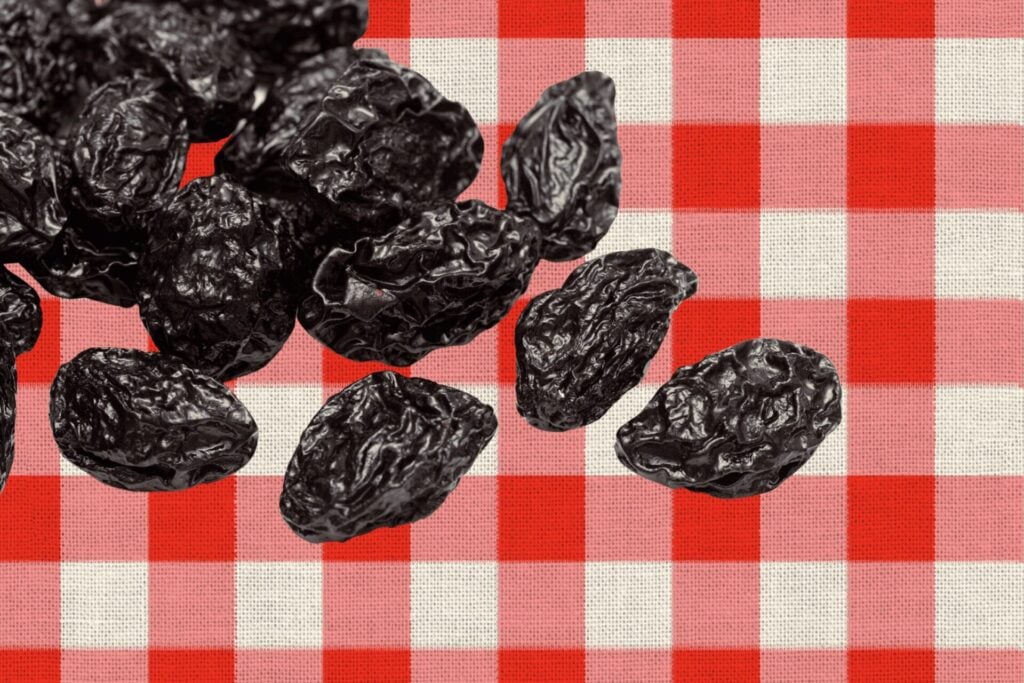
Results of a randomized controlled trial, published in 2022, suggest that eating prunes could help postmenopausal women prevent bone loss. Researchers measured the hip bone mineral density of a control group, who ate no prunes, and of a group that ate 50 grams of prunes per day. That’s roughly five or six prunes, depending on size. After a year, the control group lost density while the prune-eaters did not.
Prunes came into the picture for DB after the American medical system left her in a holding pattern. In 2018, she was diagnosed with osteopenia, or bone density loss, often a precursor to osteoporosis. Six years later, her general practitioner ordered her a DEXA scan (also called a DXA scan), a type of bone density test, that landed her with an official osteoporosis diagnosis. After the scan, DB should have seen an endocrinologist with expertise in treating older women, but the only one nearby and in her insurance network had just retired. The hospital was searching for a replacement. “I was trying to find things that I could do in the interim,” DB said.
Her general practitioner prescribed ibandronate, sold under the brand name Boniva, a medication for osteoporosis. DB took the oral version once and ended up passed out on the floor.
She returned to her GP and said she would not take ibandronate again. That’s when she brought up “the prune study,” as it’s often called. “I told her, ‘This is what I’m going to do.’ And she said, ‘Yeah, there’s some evidence that it may or may not help.’ I think she just wanted me to take the medicine,” DB said.
Anyone can develop osteoporosis at any time, though risk increases with age. It’s more common among women than men, and the risks for women start going up about one to two years before menopause due to a decrease in estrogen. Osteoporosis is more prevalent among non-Hispanic white women and Asian women than other ethnicities. People taking certain medications, such as cancer medications and glucocorticoid steroids, have a heightened risk of developing osteoporosis, as do people with a family history of the disease. It’s more prevalent among people who have had food-restrictive eating disorders and those with a small body frame, possibly due to them having less bone mass to draw from, says the Mayo Clinic.
Because osteoporosis is typically symptomless, it can go undiagnosed unless patients are proactively assessed for it, usually with a DEXA scan. (See a video of a DEXA scan here.) These scans may be covered by insurance, and the age at which you need your first one is determined by your doctor, though 65 seems to be the recommended age for people without many risk factors. DB was advised to get all follow-up DEXA scans on the exact same machine where she had her first one to make the readouts as comparable as possible.
Ibandronate isn’t the only pharmaceutical treatment for osteoporosis. There are monthly pills, quarterly injectables, and annual intravenous infusions. Some of the side effects are terrifying, like osteonecrosis (“bone death”) of the jaw – a risk mostly limited to “people taking intravenous bisphosphonates [including ibandronate] to treat cancer that has spread to the bones, or in women who are on long-term, high-dose bisphosphonates,” according to Harvard Health. Other drug options can’t be used long-term or come with other side effects, such as hot flashes, muscle pain, hair loss, and increased risk of deep-vein thrombosis.
Prunes certainly are nutritious. They’re known for their fiber content, and they deliver vitamin K, potassium, and several B vitamins. But can they really stop osteoporosis in its tracks?
Many of the same authors from the 2022 study published additional findings in 2024 on the mineral density of other bones among prune-eaters and a control group. Once again, the control group lost bone mineral density and the prune group did not.
The results are promising, though more research is needed. Randomized controlled food studies are difficult to do well on human subjects, and when they are done well, the sample size is usually small. That’s the case here. Perhaps most noteworthy of all, the two studies mentioned so far received support from the California Dried Plum Board, i.e., “Big Prune.”
Prune studies also only look at prunes and not other dried fruits…or fresh plums. Previous research published in 2011 did compare the effects of eating prunes versus dried apples on bone mineral density in postmenopausal women and found “dried plum significantly increased BMD of ulna and spine in comparison with dried apple.” I’d be curious to know how prunes measure up against a closer cousin, like figs, since they’re sometimes mentioned as another dried fruit that’s high in calcium and therefore beneficial for bone health.
DB read another peer-reviewed paper on freeze-dried blueberry powder that showed eating it “increased net bone calcium retention” among postmenopausal women. Curious, she bought some and puckered at its super-concentrated flavor. She went back to prunes.
After waiting a year, DB got an appointment with an attentive endocrinologist who reviewed all her data. The specialist was much less concerned than the GP. “If I were 30, it would be very bad,” DB said. But given her age (60) and size (5’11” with a full frame), there was no need to panic. The specialist explained that she did have osteoporosis, but only in her lower back, not spread throughout her body. DB said she got the sense that the endocrinologist wanted to prescribe ibandronate again, but because she had described the severe reaction she had the first time and her reluctance to try it again, the doctor left it alone.
She and the endocrinologist agreed on a plan. DB will continue her regiment of eating prunes and taking vitamin D, but she needs to increase her calcium supplement. She’ll keep doing weight-bearing exercises. After a year, she’ll have another DEXA scan and they will decide on future treatment based on the results. The research on prunes’ ability to slow osteoporosis isn’t convincing enough yet to rely on it, but eating a few per day in combination with all the other treatments that doctors recommend — like taking calcium and vitamin D, and weight-training — can’t hurt.