
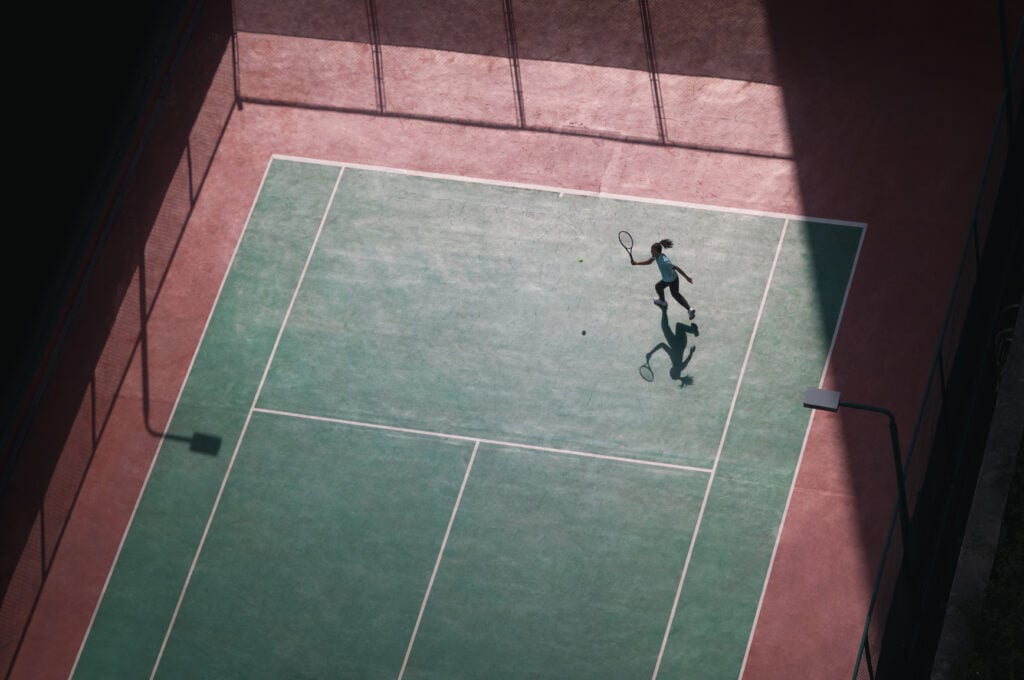
By Liz Krieger
I came back to tennis five years ago after a 25-year hiatus. It was one of those things I had loved intensely as a teenager and then just… didn’t. When I joined a local USTA team, I walked into something I didn’t expect: the most age-diverse, body-diverse group I’d belonged to in my adult life. Some of the best players are well into their 50s. Others in their late 30s and early 40s are hitting their stride, playing better than they ever did in their youth.
There’s a massage therapist whose drop shots make you curse under your breath, a young theater agent with a lethal backhand slice, and a veteran narcotics prosecutor who brings the same strategic intensity to breaking down opponents’ games. Lawyers, architects, artists — all women who might not otherwise cross paths, but who somehow ended up on the same courts at the same ungodly hours.
In every other corner of midlife, we sort ourselves relentlessly: by life stage, by income, by whether our kids play travel soccer. Maybe that’s why a recent survey found that 19 percent of US adults now play team sports, up from 11 percent in 2020 — we’re craving communities formed around something else entirely.
This team was assembled by different math: some combination of being good enough at the sport, being genuinely kind, and having that particular hunger that makes you willing to rearrange your entire week around match days.
The friendships that form around this shared obsession are also an unexpected boon considering how making new friends at midlife can sometimes feel like an awkward imposition on everyone’s already overscheduled lives. Though we come from different neighborhoods, professions, and life stages, tennis creates this thing around us — and that turns us into an “us.” There’s an ease to these new friendships that I’d forgotten was possible.
The players who’ve been at this longer teach you things you can’t learn any other way. They know when to be aggressive and when to let your opponent beat herself, when to go for the line and when to hit it back deep and wait. Patience becomes one of your best weapons as you age in this sport, something younger players with faster reflexes don’t always understand yet.
At 16, when tennis consumed my afternoons and weekends, it gave me a sense of who I was. The intensity was pure and absolute and ultimately unsustainable. At 50, the intensity is bounded. Tennis isn’t my identity, but it’s become part of how I understand myself: as someone who still shows up to learn something difficult, who still gets nervous before big matches, who still believes she can get better at something that matters to her.
My kids, who are 12 and 16, watch this whole thing with some degree of fascination and I hope, a bit of pride. They see me get up early for practice, chug coffee before 9 p.m. matches, and come home elated or dejected depending on how things went. They’ve learned that their mother has obligations to people who aren’t them, people who depend on her to be prepared and focused and fully present for something that has nothing to do with their needs.
There’s something clarifying about committing to a team at midlife. It creates a space where other adults need you to show up at your best — not your most accommodating, not your most flexible, but your most skilled and reliable. Where success depends entirely on your own preparation and execution, but where that individual effort only matters in service of something larger.
There’s another layer to tennis that makes it unusual: it’s simultaneously a team sport and a ruthlessly individual one. The USTA ratings system tracks your wins and losses, calculates your performance against opponents of various levels, and adjusts your rating accordingly. Get better, win more matches, and you might rise to a level where you can no longer compete with the teammates you’ve spent years playing alongside. It’s bittersweet in a way that other team sports aren’t. Imagine getting too good at softball and being told you can’t play with your team anymore.
But our team has figured out something special. Women who’ve moved up in level still come to practice. Those who’ve stopped competing — because of injuries, time constraints, or simply deciding they’re done with the pressure of matches — still show up to hit. We’re a fluid group, constantly shifting in who’s competing and who’s just here for the joy of it.
I find it both amusing and cool that the USTA has been championing tennis as “The World’s Healthiest Sport,” a claim that takes some real swagger in a world full of sports. But there might be something to it. The Copenhagen City Heart Study found some sports are linked to longer life expectancies with tennis players showing the biggest gain, living nearly a decade longer than non-players.
The fitness demands are absurd: the sprinting, the lateral movement, the explosive changes of direction that engage muscles you forgot you had. You’re essentially doing interval training disguised as a game. It’s also what scientists who study this stuff call a “Lifetime Sport” — because it “promotes competition and participation at all phases of life.”
But what actually makes the claim true isn’t the cardio or the strength or the hand-eye coordination, it’s the social dimension, the fact that it creates these accidental communities and friendships. (According to a USTA National study, tennis players reported significantly higher levels of social support compared to non-players.)
Of course, calling tennis the ‘healthiest’ anything glosses over the fact that it’s not a cheap sport. Court time, coaching fees, and clinic costs can easily add up to what some people pay for therapy. Which is, I suppose, how I’ve come to think of it: an investment in my mental health that happens to involve a lot of sweat.
I didn’t know I was missing all of this until I found it again. The thrill of competition, the singular intimacy being known by people who’ve watched you struggle and improve, the way an entire week can orient itself around two sweaty hours on a Saturday morning. I thought I’d outgrown this kind of intensity, or that it had outgrown me. But it turns out some things don’t leave you. They just wait, patiently, for you to return to them.