
By Leslie Price
It might seem quaint that, given the concern over reading levels in this country – and observed declines in literacy – that a coordinated, well-funded effort would be underway to pull books off school library shelves. It might also seem quaint to do this under the guise of protecting children from obscene materials, given how omnipresent and freely available obscene materials are online.
But attacks against books, and librarians, are on the rise. It’s not a new battle; in 1982, the issue made its way to the Supreme Court, which ruled that “local school boards may not remove books from school libraries simply because they dislike the ideas contained in those books.”
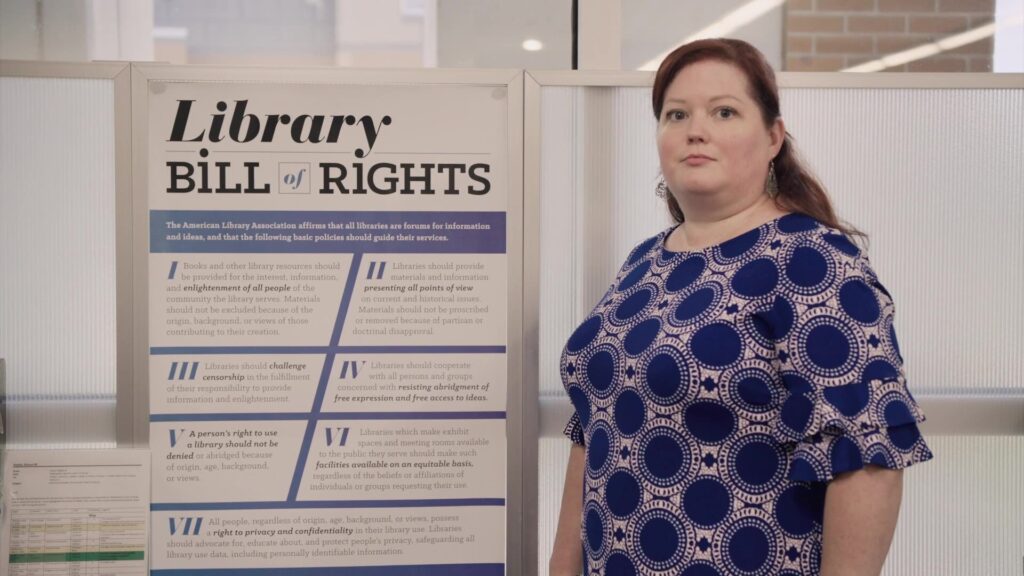
The fight over what books children should be allowed to freely access has put librarians in the crosshairs. Some have been fired, or had their lives threatened. In the new documentary The Librarians, director-producer Kim A. Snyder showcases the human toll of this violent and politicized rhetoric. As one librarian says, “If you had told me a few years ago that there would be security at a conference for librarians, I would’ve said that you were insane.” But the film is as heartening as it is infuriating. Librarians are stepping up, at great cost, and their courage is inspiring.
I spoke with Snyder to find out what surprised her about this topic, the conversations she hopes the film will generate, and more.
I want to start with the obvious question, which is: What was the impetus for this project? What made you decide to do a documentary about librarians?
I’ve been working in the documentary space for years, [specifically documentaries] that have social impact. In the fall of 2021, I learned about a list in Texas by state rep Matt Krause of 850 books that should be taken off the school shelves. It was an enormous number and it took a lot of the librarian community by shock. In some ways the list was random, but generally it targeted books about race, gender, sexuality, and sex education.
At the same time, I learned about a small group of librarians in Texas calling themselves the FReadom Fighters that were organizing librarians not only in Texas, but across the nation. Librarians were experiencing a real attack on their profession. It was a siege on those who were bravely standing up and saying, this is censorship and I won’t abide by it.
There are some pretty dramatic moments in the documentary. I’m thinking about when a librarian is speaking and a man is screaming at her. What surprised you during the making of the doc?
That the idea of arresting a librarian for upholding First Amendment rights and fighting censorship, which is something they’re trained to do, was actually something happening in the United States of America. And how cruel and vitriolic this often was, and that it was so pervasive.
You focus on Texas and Louisiana. Why those states?
Well, we started in Texas because of the Krause list, but then we started to understand that this was pervasive throughout the entire country. In some states, there were laws, like in Florida with the “Don’t Say Gay” bill. But we realized it was [popping up] in a lot of states where people might not expect it, like New Jersey.
Book challenges have existed for a long time. What has changed over the past few decades, and perhaps even more recently?
The librarians that I was involved with would say that, in the past, there might’ve been one or two challenges in a year – or none – to a book, and that those rights of parents were always in place. The protocol was there. It worked.
This was of [an unprecedented] scale and scope. A lot of this happened in the midst of the pandemic, where there was vulnerability and a politicization of certain fears. Politicization happened around masking and vaccinations, then it turned to the books as a way to harness, I think, a particular political block. This was done with misinformation. As you see with Courtney Gore, who is a Republican and had deep concern that there was obscenity in school libraries. She does her research and realizes this is misinformation, and she starts to question why that would be.
There’s been a lot of conversation about free speech and freedom of expression when it comes to a celebrity like Jimmy Kimmel, but this film shows what it’s like to defend free speech when you’re a normal person. A lot of these women have been left high and dry by their communities, by their school boards, and they had to go it alone. I’m thinking of the woman who says she always carries multiple guns with her and she sleeps with a gun under her bed.
They are people with everything to lose and so much to risk who are standing up to bullies and extremists in their towns. It is so admirable, and they are such role models for standing up for what’s right and for kids. These women are just saying, no, we’re not going to feel intimidated.
I see them as courageous patriots who are standing up for First Amendment rights, which, by the way, is a completely nonpartisan issue. [The woman you referenced] will tell you that she’s a registered Republican, for example, and a devout Christian, and that she was brought up to uphold the very principles for which she’s vilified for protecting.
Before this conversation, I spoke with my mom about the film, because she’s been a public librarian for more than 40 years. She wanted to know if you think that this is due to the fact that libraries are representing more people on the shelves than they used to. The books were mostly about straight, white, and often Christian characters, and now there are stories of queer people, realistic portrayals of different races, the history of slavery, etc. Do you think that part of this is a desire to turn back the clock with what is on the shelves?
A hundred percent. If I were having a conversation with your mother directly, I would probably ask her if she would agree that the job of trained librarians is to maintain a dynamic collection of books that reflects the society that we’re living in. As one librarian said, if you’re a vegan, we have books for you. If you’re a hunter, we have books for you. We have books for everyone. There’s definitely resistance to books that, as you said, reflect the diversity of the communities that people live in. Oftentimes, especially for marginalized kids, kids of color, kids who are queer, these are books that – as they will tell you – save lives because they make them feel heard, seen, and less alone.
You were involved in the making of a short film, Trevor, that led to the creation of the Trevor Project. What would be a great outcome from this documentary?
We want to reach the middle. People say there’s no middle. It’s not true. I think the vast majority of Americans are yearning to have civic engagement and civic dialogue. We always prided ourselves on being a nation where people could agree to disagree and still break bread together at the end of the day. And that was okay. We hope to encourage that kind of dialogue, and for people to get more involved in their own communities and their libraries. We hope the film can help to sustain small and rural libraries when their funding has been cut. And we’re hoping to grow what I call Librarians Without Borders, because they are a noble profession and they are the firewall. It is so essential that the idea of freedom of expression be upheld.
I’m hoping to at least come to a place where we can agree that our librarians, who are public servants, just like firemen and all kinds of other people you grow up admiring, not be threatened with criminalization for simply defending our rights.
How much of this is prompted by parents, and how much of it is people who don’t have children at the school?
Well, look, everybody as a taxpayer has the right to know what their school board’s doing because it’s a village. If I don’t have kids, I should still be invested in what happens to the children in my town. Your tax money is going to that. What’s concerning is when there are people who are part of an organized agenda that doesn’t believe in separation of church and state – or public education in general – who are going in to tear all of that apart and dictate what a majority of peoples’ kids can and can’t read. If you want to do that in your own house, that’s completely your right. But you can’t come in and tell the rest of the community what their kids should and shouldn’t read. You can have parental rights over your own kids and everyone should. Part of what we show in the film is that there is a much more concerning agenda behind all of this. It’s not really about the books, it’s about controlling information.
There are people who may have, as I said during the pandemic, coalesced around the idea of parental rights, whether you agree with it or not. But then there was a point where the attention was diverted to this issue of the books and people were being fed misinformation about obscenity. There is [already] criteria [for that issue]. There’s something called the Miller Test about what constitutes obscenity or pornography.
Calling a scene [featuring sexual assault] in a book like Beloved by Tony Morrison “pornography” is, I think, offensive. We can go and get porn off the internet. This is literature. As a librarian said the other night, if you see that as pornography, I have to question where you’re coming from because I’m concerned about you.
The film is being screened all over. How can people see it if they can’t make it to a screening?
Well, they should go to our website, which is the librariansfilm.com, because we’re now up to 70 or 80 locations throughout the country.
It is not in a theater near you, you can request a screening. We’re doing a lot in conjunction with local libraries. It will be broadcast come February on demand and on PBS’s Independent Lens. And we’re showing globally.
Will it be available through libraries via Kanopy?
Yes, it will. We’re working directly with Kanopy and libraries across the country are very excited. We’re also showing it at a lot of the librarian associations, and the conference of small and rural libraries.
What has the response been from librarians?
In short: really emotional. We showed it and 700 or 800 librarians were all on their feet weeping, basically. It’s emboldened a lot of librarians to feel less alone. To come forward. The film has, in a way, become a movement.