
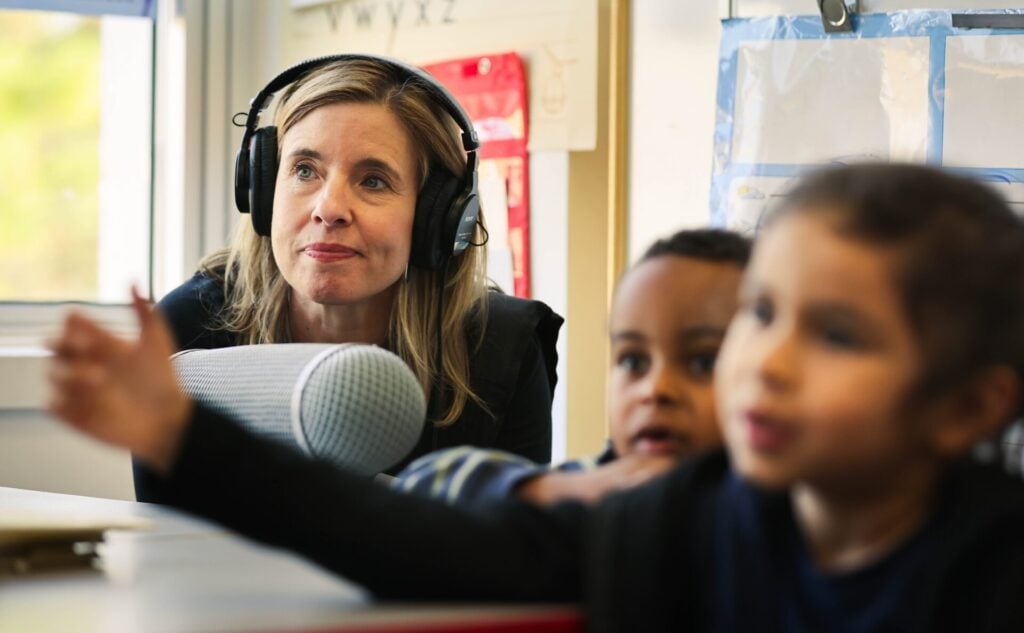
There are few subjects more fraught than education. And right now there’s genuine concern — veering into the existential — over our education system. Into the fray steps journalist Emily Hanford with a new season of the documentary podcast Sold a Story (you know, the one that basically transformed reading instruction in this country after its first season). We spoke with her by phone last week to find out how this season differs and what she hopes people will take away from her reporting.
I’m curious how you think about this project and its audience. Particularly the listeners who are teachers.
We knew going in to the first season of Sold a Story that we already had intense interest from teachers in particular and educators more generally. And from a lot of parents, a lot of moms. We were surprised that it jumped species to a general audience. We started to get notes from people like, “I don’t have kids. I’ve never thought about education, and I was really riveted by this podcast.”
Can you sum up what this season is about? You focus on Direct Instruction, which I thought I understood, but didn’t.
People, when they hear Direct Instruction, assume that means lecturing or explaining things. That’s not what it is at all.
One of the sons [of DI architect Siegfried “Zig” Engelmann] said, “He should have called it conceptual learning, because that’s actually what it’s about. How do you help a kid understand a concept?”
I saw Direct Instruction many years ago, one of those old videos of Zig teaching. I thought that looks strange. We get into this in the final episode: Why is there such deep disdain? People dismiss it. Look at that call and response. It’s authoritarian. He made scripts, which are both Direct Instruction’s biggest strength and its absolute Achilles’ heel.
Designing instruction is complicated and difficult. And what we have done as a nation is left that up to a lot of teachers on their own.
Do you think we are in a moment where people are open to a new conversation about education in this country?
There’s an opportunity to talk about education in a productive way. One reason is because so many teachers want to talk about it. Most teachers are in the profession because they really care about children, and they really care about learning.
I’m not interested in being provocative for the sake of being provocative. I’m trying to nudge people and make them think about things in a different way.